Uncover Criminal Risk. Strengthen Compliance. Make Smarter Decisions.
In today’s risk-driven environment, access to accurate, up-to-date criminal intelligence is essential for compliance, due diligence, and investigative workflows. Vital4CRIM delivers real-time criminal records and court data sourced from thousands of governments and public records — helping organizations uncover risk faster, reduce blind spots, and operate with confidence.
Built for Non-FCRA Intelligence & Compliance Use Cases
Vital4CRIM is designed specifically for non-FCRA permissible use cases, supporting teams responsible for:
️ This solution is not intended for FCRA-regulated purposes.
Real-Time Criminal Intelligence – Straight from the Source
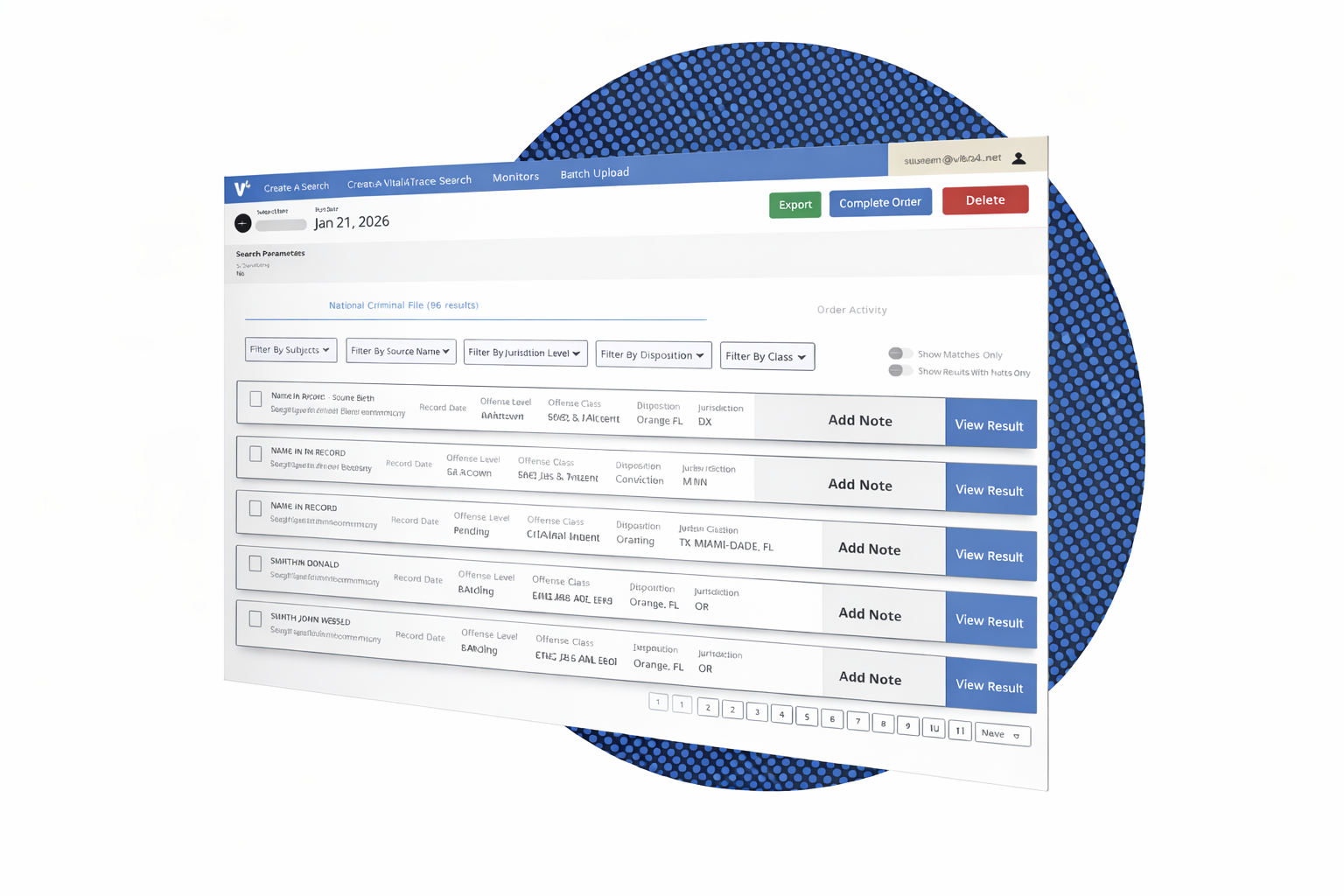
Vital4CRIM aggregates criminal records and court activity from thousands of federal, state, county, and local sources, updated continuously to ensure accuracy and relevance.
Coverage includes:
Unlike conviction-only datasets, Vital4CRIM provides a full view of court activity within a jurisdiction, giving risk teams deeper visibility into emerging or ongoing background screening concerns.

By combining real-time data ingestion, intelligent matching, and precision filtering, Vital4CRIM helps organizations:
Vital4CRIM delivers real-time criminal intelligence that helps organizations identify risk earlier, make faster decisions, and operate with confidence. Built for non-FCRA compliance and investigative use cases, the solution equips financial institutions, corporate risk teams, screening providers, and digital platforms with comprehensive court and criminal data—going beyond conviction-only records to surface meaningful risk signals tied to people, businesses, and ongoing activity.
Vital4CRIM is available through multiple deployment options:
Criminal exposure is a key indicator of financial crime, fraud, reputational risk, and regulatory liability. With continuously updated court and criminal data, Vital4CRIM equips your organization with the intelligence needed to act early, act confidently, and stay compliant.

Ready to strengthen criminal risk intelligence?
Take a smarter, faster approach to criminal data screening.
Insights from Vital4

Across 2026, FinCEN withdrew, delayed, or eliminated one prescriptive AML mandate after another. In the same year, it proposed a rule that makes your program harder to defend, not easier. The checkbox is receding; the judgment is yours.

FATF just redrew its grey list. Most compliance programs still treat country risk as a field they set at onboarding and forget. When the map changes every few months, a stale map is an open door.

Banking-as-a-service lets a chartered bank reach millions of customers it never meets. A new federal proposal is a reminder that the bank still owns every one of them.
A criminal background check scans local, national, and international databases, court records, and public records to assess a person’s or entity’s criminal history as part of a broader risk profile.
A conviction-only check surfaces only finalized criminal convictions, missing active or pending cases, warrants, and other court activity. A full court-records check captures the complete picture of court activity within a jurisdiction. Vital4CRIM takes the latter approach, surfacing arrests, open cases, warrants, and corrections data — not just convictions — for a more complete view of emerging or ongoing risk.
Reputable criminal background screening providers protect data through encryption in transit and at rest, strict access controls, and independent security audits. Vital4 maintains SOC 2 (Non-CPA) certification, reflecting its commitment to data security and operational integrity across its compliance data products.
An FCRA background check is governed by the Fair Credit Reporting Act and used for employment, tenant, or credit decisions involving consumers, with specific consent, disclosure, and dispute-resolution requirements. A non-FCRA compliance check, like Vital4CRIM, is used for AML, KYC, third-party risk, and investigative purposes outside those consumer-report regulations, and isn’t intended for FCRA-regulated decisions.