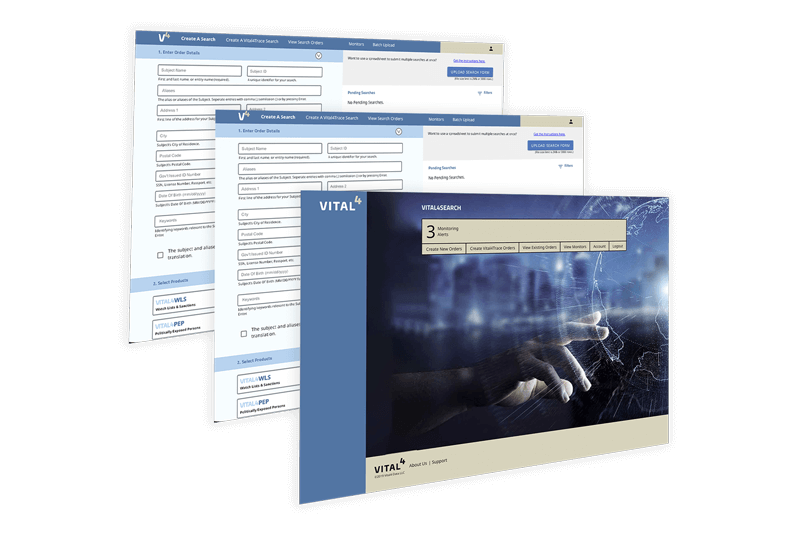
Most AML screening software relies on lists that someone else collected. Vital4 collects its sanctions, watchlist and PEP data itself, directly from government and authoritative sources in 240+ countries, and updates critical lists in under a minute once a source publishes.
The result is cleaner matches, lower cost and an audit trail you can defend to an examiner.
See how you can trust Vital4’s direct-source, owned datasets in comparison to your current AML compliance data provider. Book a PROOF OF CONCEPT Trial →
No aggregators. No AI-scraped lists. Traceable to the source.
AML screening software checks customers, beneficial owners and counterparties against sanctions and watchlists, politically exposed person (PEP) databases and adverse media. It should run at onboarding and continuously afterward, because lists and risk status change, and it should log every search and decision so you can show a regulator what you checked and why.
Fewer false positives. Vital4 Adverse Media uses patented Contextualized Entity Extraction to tie negative context to the specific person or business named, not the whole article. That delivers up to 100% fewer false positives in adverse media screening compared with keyword-based approaches. Across the rest of the platform, accurate source data and secondary identifiers such as date of birth and nationality cut noise further.
Data we own. Vital4 collects and maintains its watchlist, sanctions, PEP and adverse media data directly from primary sources. There is no third-party aggregator between the issuing authority and your result, so you see the data as published, with source-level traceability.
Lower cost. Because Vital4 builds its core data itself, there is no third-party licensing markup to pass on, and no manual refresh cycles or heavy integration work. You can start in a browser, through the API, or with batch files.
Customers see up to 40–50% lower total cost compared with legacy platforms.
Operating in Australia? Vital4 offers AUSTRAC-specific screening from $500 AUD per month.

| Comparison point | Aggregated providers | Vital4 direct-source data |
|---|---|---|
| Where the data comes from | Licensed or re-published feeds | Collected directly from government and authoritative sources |
| Update speed | Depends on the provider's refresh cycle, often daily or batched | Critical lists updated in under a minute once a source publishes |
| Traceability | Often limited to the provider's copy | Every result traceable to its original source |
| Adverse media | Typically keyword-based | Patented entity-level context; up to 100% fewer false positives |
| Cost | Aggregator margin built into the price | No third-party licensing markup |
Patented Contextualized Entity Extraction models extract and read content to lower false positives.
VITAL’s patented, and embedded Agentic AI models extract entities, read result content related to the entities, and reduce false positives up to 100% of the time for Adverse Media.
Reduce regulatory risk exposure and access a data pipeline collected directly from verified sources.
VITAL4 owns its entire data pipeline —
PEP , Watchlist and Sanctions collected
directly from verified sources, updated
in less than 1 minute after source publication, FCRA & GDPR-conformant with full source traceability. Trusted by the world’s largest financial institutions as the Global Compliance Benchmark.
Scale instantly without manual refresh cycles or legacy overhead.
VITAL4’s modern architecture scales instantly— no manual refresh cycles, no third-party licensing mark-up, no legacy integration overhead. You pay
for precision and performance, not inherited inefficiency.
99% of competitors license third-party data and run on legacy platforms, leading to stale updates, high markups, and massive alert volumes. Because they lack embedded Agentic AI, their users pay more for lower-quality data.


VITAL4 owns the entire data pipeline and applies proprietary AI to extract and structure data directly from the source. This eliminates the cost and quality gaps, delivering the Global Compliance Benchmark with 40–50% total savings.
Serving Australian reporting entities? See our AUSTRAC AML screening software and the free AUSTRAC financial crime compliance guide.
AML screening software checks customers, beneficial owners and counterparties against sanctions and watchlists, politically exposed person (PEP) databases and adverse media to flag financial crime risk. It should run at onboarding and on an ongoing basis, because lists and risk status change, and it should keep an audit trail of every search and decision.
False positives usually come from name-only matching, where anything sharing a name is flagged. Better software uses secondary identifiers such as date of birth and nationality, accurate source data and context-aware analysis, so coincidental matches are cleared. In adverse media, linking negative context to the specific named person or business, rather than to the whole article, is the biggest lever.
Compare five things: who owns the data and whether it is collected directly from the source, how quickly critical lists are updated, how the platform handles false positives, whether pricing is transparent and scalable, and whether every result is traceable for auditors and examiners. Ask each vendor to run the same sample of names so you can compare real results.
Providers that license or re-publish aggregated feeds add a layer between the issuing authority and your result. That layer can delay updates, drop or flatten fields such as aliases and original-script names, and add cost. Data collected directly from government and authoritative sources can be traced to the original, which makes results easier to defend to a regulator.
Start with a free trial, or request a proof of concept: you screen your own test names through Vital4, and your team compares the results with your current provider’s, including match quality, false positives, source traceability and update speed. Request either through the Contact Us page or Get a Demo.