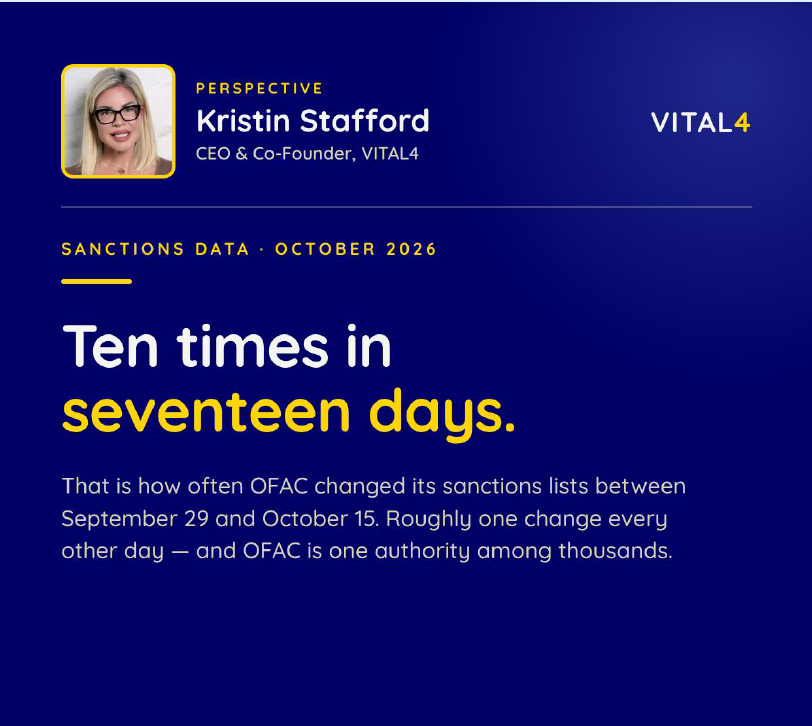
THE ANSWER MOST FIRMS CANNOT GIVE
Not today. Not necessarily this week.
Designations. Removals. Updates. Licences.
Every one of them is a change that either reached your analyst — or is still sitting somewhere upstream of them right now.
Most compliance teams have no way to tell which.
HOW MOST SCREENING DATA TRAVELS
Authority → aggregator → you.
Most screening data in this market is bought from an aggregator, reshaped into that aggregator’s own format, and passed down the chain.
Every hop adds delay. Every reformat is a chance for something to be dropped, renamed, or flattened into a field that doesn’t quite fit.
You are not screening against what the authority published. You are screening against someone else’s copy of it.
WE BUILT VITAL4 THE OTHER WAY
We don’t buy our data. From anyone.
- VITAL4 is the only data provider in market that does not buy third-party data for watchlist, PEP or adverse media
- Collected from thousands of primary government published sources
- Returned exactly as the issuing authority published it — no house format, no model reshaping the record
- Critical sources live within seconds of publication
WHAT IT COSTS WHEN IT FAILS
One character. £160,000.
OFSI penalised a UK bank £160,000 after a designated person opened an account using a passport with a spelling variation of their name.
No alert fired. Twenty-four payments moved before anyone caught it. OFSI’s finding noted the bank had no enhanced data to reconcile the variation.
ASK YOUR PROVIDER THIS WEEK
Where does this data actually come from? And how fast does a change reach my analyst?
If they hesitate on either one, you have your answer.
Kristin Stafford
CEO & Co-Founder, VITAL4
FAQs
OFAC has no fixed update schedule. It changes its lists whenever it adds, amends or removes a designation, so changes can come days apart or several times in a week. In one recent stretch it changed its lists ten times in 17 days. Screening only works if your data reflects those changes quickly.
Many providers buy data from an aggregator, which reformats it into its own structure before passing it on. Each hand-off adds delay and can drop, rename or flatten fields. You end up screening against a third party’s copy of the list instead of the authority’s original publication.
Ask where each list comes from and whether the provider collects it directly or buys it. Ask how long a change takes to reach your analysts, and whether that delay is logged. Ask how name variants and original-script spellings are preserved. A provider that can’t answer clearly should give you pause.
Vital4 collects its watchlist and sanctions data directly from primary government sources and does not buy it from aggregators. Critical lists update in under one minute, and records can be traced back to the issuing authority’s original publication.