Generative AI has captured the imagination of nearly every industry — and compliance is no exception. The promise is seductive: feed a large language model the right prompt, point it at open-source datasets, and let it do the work of a dozen analysts. Open-source tools, meanwhile, offer the appeal of zero licensing costs and community-driven transparency.
For many use cases, these technologies deliver real value. But when the stakes involve regulatory enforcement, criminal sanctions, and the integrity of global financial systems, generative AI and open-source data have a fundamental problem that no amount of fine-tuning can solve: they don’t own the truth.
The Compliance Data Problem Is Not a Model Problem
The most sophisticated AI model in the world is only as reliable as the data beneath it. In compliance — particularly in AML, KYC, and sanctions screening — accuracy is not a “nice-to-have.” It is the entire point. A single missed sanctions hit can result in multi-million dollar penalties, criminal exposure, and catastrophic reputational damage. A flood of false positives, meanwhile, paralyzes operations and erodes trust in the compliance function itself.
Generative AI models — whether proprietary or open-source — are trained on massive corpuses of internet text. They are brilliant at pattern recognition, language generation, and synthesis. What they are not is authoritative sources of regulatory truth. They do not maintain direct data pipelines to OFAC, the UN Consolidated List, His Majesty’s Treasury, Interpol, or the thousands of regional watchlists that change — sometimes multiple times per day — across 200+ jurisdictions.
In compliance, the question is never "can AI generate an answer?" The question is "can you prove to a regulator where that answer came from, and that it was current at the moment of decision?"
The Five Gaps Generative AI Cannot Close
When organizations attempt to build compliance screening capabilities on top of generative AI and open-source tooling alone, they inevitably encounter structural limitations that no amount of prompt engineering or RAG architecture can resolve.
- Data provenance and auditability. Regulators do not accept “the model said so” as a defensible position. Every screening decision must be traceable to a specific source, updated at a specific time, with a documented chain of custody. Generative AI outputs are probabilistic — they cannot provide the deterministic, source-attributed results that audit trails require. Companies that own their data pipelines and collect directly from authoritative government and regulatory sources can provide that traceability. Open-source models cannot.
- Real-time data freshness. Sanctions lists are living documents. OFAC updates can appear with zero advance notice. A person or entity cleared yesterday may be designated today. Generative AI models have training cutoff dates and cannot inherently reflect changes that happened an hour ago — or even a day ago. Even retrieval-augmented generation (RAG) systems are only as fresh as the underlying data they retrieve, and open-source sanctions datasets are notoriously delayed.
- Entity resolution across languages, scripts, and cultural naming conventions. Compliance screening is a global challenge. Matching Arabic, Latin, and Cyrillic script variants of the same name — while distinguishing the actual sanctioned individual from the millions of people who share that name — requires deep contextual entity resolution trained on compliance-specific data, not generic internet text.
- False positive management at scale. The dirty secret of compliance screening is that legacy systems — and naive AI implementations — drown teams in false positives. When 95% or more of your alerts require no action, your analysts burn out, your costs spiral, and real risks slip through the noise. Reducing false positives requires proprietary scoring models trained on millions of adjudicated compliance decisions.
- Regulatory accountability and liability. When a bank or fintech relies on an open-source LLM for screening and something goes wrong, there is no vendor to hold accountable, no SLA to enforce, and no compliance team on the other end of the phone. SOC 2 certifications, documented data sourcing methodologies, and dedicated compliance expertise are not features of open-source projects — they are features of purpose-built compliance companies.
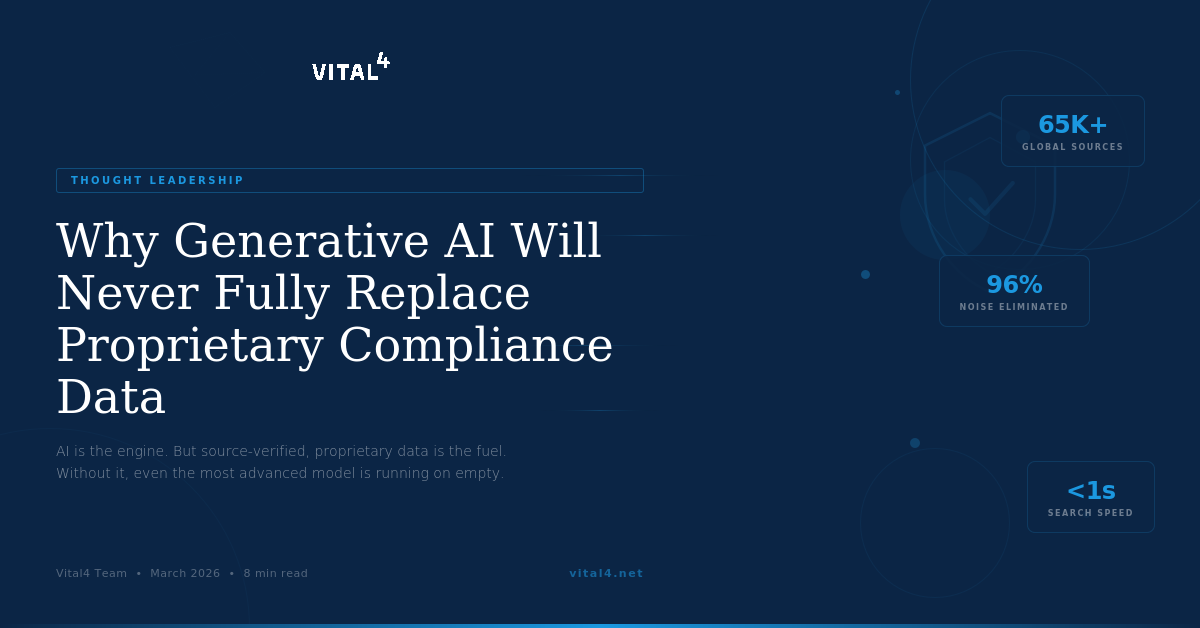
65,000+
Authoritative Global Data Sources
96%
Reduction in Screening Noise
<1s
Search Results Across Global Data
Where Generative AI Does Belong in Compliance
None of this means generative AI has no role in compliance. It absolutely does — but as an accelerant layered on top of authoritative data, not as a replacement for it.
The most forward-thinking compliance platforms are already integrating AI to enhance human decision-making: automating adverse media analysis, generating SAR narrative drafts, surfacing behavioral anomalies in transaction data, and enabling natural-language querying of complex regulatory databases. These are high-value applications where AI augments a proprietary data foundation rather than attempting to substitute for one.
The critical distinction is the architecture. AI that operates on top of curated, source-verified, continuously updated compliance data produces defensible intelligence. AI that operates on top of stale training data and open-source aggregations produces sophisticated guesses — and in compliance, sophisticated guesses carry the same regulatory risk as no screening at all.
The Enduring Value of Owning the Data
The compliance technology landscape will continue to evolve rapidly. New models will emerge, open-source communities will build impressive tooling, and the capabilities of generative AI will expand in ways we cannot fully predict. But the fundamental architecture of regulatory compliance — the need for authoritative, traceable, real-time data collected directly from the source — is not a technology trend. It is a structural requirement imposed by the nature of regulation itself.
Companies that own their data pipelines, invest in direct relationships with global regulatory authorities, and build proprietary AI specifically trained on compliance-grade datasets are not competing in the same category as open-source tools. They are solving a different problem: not “can we screen?” but “can we prove we screened correctly, with current data, from a defensible source, and did so at the moment it mattered?” That is the question regulators ask. And it is the question that generative AI, operating on its own, cannot answer.
AI is the engine. But proprietary, source-verified data is the fuel. Without it, even the most advanced model is running on empty.
The organizations that will thrive in the next era of compliance are those that embrace AI as a force multiplier while recognizing that the data underneath it is not a commodity — it is the competitive advantage. It is the source of truth. And it cannot be replicated by a model trained on the open internet.
VITAL4
See What Proprietary Data + AI Can Do
Vital4 combines 65,000+ authoritative global sources with patented AI to deliver compliance intelligence you can trust — and defend.
REQUEST A DEMO